
2024年湖南长沙中考英语试题及答案
试卷分为四个部分,共8页,61小题,时量100分钟,满分100分。
第一部分 听力(共两节,满分20分)
第一节(共5小题;每小题1分,满分5分)
听下面5段对话。每段对话后有一个小题,从题中所给的A、B、C三个选项中选出最佳选项。听完每段对话后,你都有10秒钟的时间来回答有关小题和阅读下一小题。每段对话读两遍。
1. What does John want to be in the future?
A. An artist B. A teacher. C. A scientist.
2. What is the boy’s hobby?
A. Collecting coins. B. Playing chess. C. Riding bikes.
3. What are the speakers talking about?
A. A kite festival. B. A sports festival. C. A film festival.
4. How did the woman come to Changsha?
A. By bus. B. By car. C. By train.
5. What would the woman like to drink today?
A. Milk. B. Tea. C. Coffee.
第二节(共15小题;每小题1分,满分15分)
听下面6段对话或独白。每段对话或独白后有几个小题,从题中所给的A、B、C三个选项中选出最佳选项。聽每段对话或独白前,你将有时间阅读各个小题,每小题5秒钟;听完后,各小题将给出5秒钟的作答时间。每段对话或独白读两遍。
听第六段材料,回答第6、7题。
6. How is Betty feeling now?
A. Satisfied. B. Worried. C. Angry.
7. What will Betty do in class tomorrow?
A. Make a presentation. B. Write a poem. C. Draw a picture.
听第七段材料,回答第8、9题。
8. When did Lily move to the new town?
A. Yesterday. B. A week ago. C. Two weeks ago.
9. What does the man think of his neighborhood?
A. Safe. B. Quiet. C. Noisy.
听第八段材料,回答第10、11题。
10. What does the man want to do before noon?
A. Post a letter. B. Make a cake. C. Send an e-mail.
11. Who is going to have a birthday party on Saturday afternoon?
A. Dave. B. Alice. C. Bob.
听第九段材料,回答第12至14题。
12. Where does the conversation take place?
A. In a restaurant. B. In a hospital. C. At school.
13. What is the relationship between the speakers?
A. Waiter and customer. B. Driver and passenger. C. Classmates.
14. How long has it been since the speakers last met?
A. 12 years. B. 13 years. C. 15 years.
听第十段材料,回答第15至17题。
15. What is Tim doing these days?
A. Preparing his paper. B. Reading a book. C. Doing sports.
16. What sport do most students like best according to Tim?
A. Ping-pong. B. Basketball. C. Volleyball.
17. Why does Beth want to take a walk?
A. To meet friends. B. To relax herself. C. To walk her dog.
听第十一段材料,回答第18至20题。
18. What excited the speaker in Africa?
A. Running water. B. Freely running animals. C. Friendly people.
19. Which place does the speaker plan to visit next year?
A. Russia. B. America. C. Australia.
20. Why does the speaker love travelling?
A. To visit relatives. B. To enjoy staying alone. C. To experience something new.
第二部分 阅读(共两节,满分30分)
第一节(共10小题:每小题2分,满分20分)
阅读下列材料,从每题所给的A、B、C三个选项中选出最佳选项。
A
International Summer Camp 2024 Edward Educational Company was set up in 1999, It has rich experience in providing educational trips for children. Our camp is located in (位于) the Swiss Alps. Hie mountains, forests and lakes here provide a playground for young adventurers (冒险者) ? Three age groups The three age groups allow children to make friends of similar ages from different countries. ? Plenty of activities
? Cultural exploration (探索) Switzerland (瑞士) has many traditions like chocolate making. Through ow summer camp, children will learn more about this country. For further information, please call us at 257-8900. |
 Our camp activities include rock climbing, horse riding, painting and much more. But hunting (猎捕) wild animals is not allowed.
21. When was Edward Educational Company set up?
A. In 1999. B. In 2014. C. In 2024.
22. What can children do at the camp?
A. Join four age groups. B. Learn more about Switzerland. C. Ride horses and hunt wild animals.
B
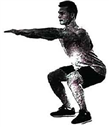
What should you do when you can’t find the time to do a long workout? Have you heard of exercise snacks (零食式锻炼)?
Exercise snacks are a popular and inventive new way for people to stay fit. Instead of spending hours on the playground, people break that “large meal” into exercise “snacks”. These exercises can last anywhere from 20 seconds to two minutes. Then you can have a rest for 30 minutes to four hours before another snack.
It is reported that exercise snacks can be as useful as traditional exercise methods. Just three exercise snacks a day can benefit (使受益) your physical health. Besides that, there are lots of other benefits. Your concentration (专注力) and creativity get better, and you can become more productive. Also, “snacking” throughout the day stops you from sitting too long.
There are so many acceptable exercise snacks, like doing sit-ups, jumping rope or running up and down some stairs (楼梯). But for those who don’t know where to start, here are some helpful exercise choices:
Exercises such as lifting weights will satisfy the needs. Since most people don’t keep weights at their offices, lift full water bottles.
Squats (深蹲) — moving your body as if to sit down while keeping your back straight. Five to ten of these should make a good snack.
For those who don5t like traditional exercises, simply turn up the music. Pick a lively song and start dancing. It’ll make for a fun workout.
What are you waiting for? Let’s get moving. Your body will thank you for it!
23. How long can an exercise snack last according to the passage?
A. 20 seconds to two minutes. B. 30 minutes to four hours. C. Five to ten minutes.
24. Which is an acceptable exercise snack mentioned in the passage?
A. Doing math exercises. B. Eating snacks. C. Doing sit-ups.
25. What is the writer’s attitude (态度) to exercise snacks?
A. Doubtful. B. Unclear. C. Supportive.
26. What is the main purpose of the passage?
A. To change traditional eating habits.
B. To introduce an inventive new way to stay fit.
C. To encourage people to do long-time outdoor exercise.
C
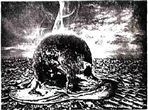
The Four Seasons, written by the Italian musician Antonio Vivaldi, was first played about 300 years ago. Since then, it has enjoyed worldwide popularity.
The great musical work includes four parts: “Spring”, “Summer”, “Autumn” and ‘‘Winter”. Each part brings to mind the season it is meant to describe. “Summer”, for example, begins slowly. Listeners can easily picture a hot, lazy summer day when nobody wants to move. When you listen to “Autumn”, a harvest (收获) celebration will readily come to mind.
But now, Hache Costa, a music director in Spain, has decided to give the old work a fresh feel. He says the climate (气候) today is very different from what it was in the 1700s. The Four Seasons would be “a lot dirtier” if it were written now.
Costa has “updated” the musical work to make it match the realities of the modem world. The ‘“updated” musical work has been played in Madrid, Spain. The performance takes place in front of a screen. As the musicians play, a video shows the effects (影响) of climate change, such as forest fires and unusually dry weather.
After enjoying it, people find the new “Summer” now sounds noisier and more powerful. Because of global warming (全球变暖), the other three seasons have become shorter. Costa says he expects people to feel “really sad” after listening to the new Four Seasons.
“I really want more people to become truly aware of (意识到) what is happening to our planet.” says Costa, “And I believe Vivaldi would not be angry with my changes.”
27. What do we know about The Four Seasons?
A. It is still unpopular now. B. It was written by Hache Costa. C. It was first played about 300 years ago.
28. What will come to mind when we listen to the old “Autumn” according to the passage?
A. Forest fires and dry weather. B. A harvest celebration. C. A hot lazy day.
29. Which is close to the underlined word “updated” in meaning in Paragraph 4?
A.提上日程 B.追根溯源 C.赋予新意
30. Why did Hache Costa give the old work a fresh feel?
A. To call on more people to love music.
B. To raise public awareness of climate change.
C. To present the story of Antonio Vivaldi’s colorful life.
第二节(共5小题;每小题2分,满分10分)
阅读下面短文,从短文后的选项中选出可以填入空白处的最佳选项。每个选项仅使用一次。
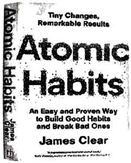
You’ve probably heard of books that will change your life. And a lot of readers agree that the book Atomic Habits (《原子习惯》) will meet your needs.
James Clear, who did a lot of research on formation of habits, is the writer of Atomic Habits. 31 It has sold over 15 million copies and has been translated into more than 50 languages. And his website receives millions of visitors each month.
32 That’s because the book introduces a practical system (系统) for creating good habits and breaking bad ones. Readers everywhere are very interested in Clear’s “science of tiny habits”.
In the book, file writer suggests trying to get 1% better each day. For example, you’d like to exercise but you don’t think you have the time or energy. Clear suggests starting with two minutes a day. Over time, the effects of this habit will increase as you repeat the actions. 33 “All big things come from small beginnings,” says Clear.
Clear continues with the following advice: Don’t focus on (聚焦) what you want to achieve. 34 For example, two men want to break the habit of smoking. When offered a cigarette (香烟), one says, “No, thanks. I’m trying to give up smoking.” The other says, “No, thanks. I’m not a smoker.” While the first man still sees himself as a smoker, the second man doesn’t. Clear says, “Bad habits will die more easily if you focus on who you want to become.”
Atomic Habits will reshape the way you think about progress and success. 35 Slowly but surely, it will have a great effect on your health, job and relationships.
A. Why is it so popular? B. Instead, focus on who you want to become. C. He calls these repeated actions “atomic habits”. D. This book is a No. 1 New York Times bestseller. E. Also, it will give you the tools you need to change your habits. |
第三部分 语言运用(共两节,满分25分)
第一节(共10小题;每小题1.5分,满分15分)
阅读下面短文,从每题所给的A、B、C三个选项中选出可以填入空白处的最佳选项。
The China International Search and Rescue Team (CISAR) was formed in 2001. It 36 help and hope to those whose lives are changed by a storm, an earthquake, or any other natural disaster (灾难).
After long and 37 training, the Chinese team went on its first international rescue (救援) tasks in 2003. That year, the team helped save lives after earthquakes in Algeria and Iran. It was the first time that the CISAR had worked outside China, and the team 38 high praise for their bravery and skill. Since then, the CISAR has completed lots of rescue 39 — they braved terrible conditions to rescue people in Indonesia, Haiti and Pakistan.
Rescue workers are trained to find people, treat injuries (伤痛), and 40 food, water, and other things. They have to be able to do difficult work when it is very 41 . For example, there is usually no electricity or water after a disaster, and there may be illnesses and accidents. Rescue workers get to save lives, but they must also deal with the dead. That means they have to be 42 in both body and mind. Rescue workers must have big 43 , too. It takes lots of love and courage to risk (冒险) their own lives to 44 someone else’s. The members of the CISAR are always ready to go wherever help is needed.
Rescue workers leave their homes and families for a job that offers little pay and less sleep. We can’t imagine how much they have sacrificed (牺牲) selflessly. We don’t even know most of their names. They are really 45 heroes!
36. A. closes B. sells C. brings
37. A. careful B. poor C. useless
38. A. gave B. won C. missed
39. A. tasks B. mistakes C. excuses
40. A. give up B. hand out C. cut down
41. A. comfortable B. safe C. dangerous
42. A. weak B. strong C. slow
43. A. hearts B. mouths C. eyes
44. A. waste B. enjoy C. save
45. A. unskilled B. unsung C. untrained
第二节(共10小题|每小题1分,满分10分)
阅读下面短文,在空白处填入1个适当的单词或括号内单词的正确形式。
Chinese New Year is a great celebration. It 46 (mark) the end of the winter season and the beginning of spring. According to tradition, people like to give flowers and fruits 47 each other during Chinese New Year, because they carry many special 48 (meaning). They represent (象征) the earth coming back to life and best wishes for new beginnings,
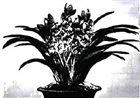
Orchids (兰花) come in many colors, but many people like purple and red ones for Chinese New Year. They are believed 49 (represent) love and beauty. Orchids say, “Wish you to be 50 (luck), successful and happy.” During the holiday period, this plant is a must.
Peonies (牡丹) are like soft clouds in pink, red and white. They are beautiful and can brighten up someone’s day. Red peonies 51 (give) to people to show love and care. Peonies say, “You are special to me.” They are also a symbol of wealth and 52 (rich).
Kumquats (金橘), with 53 (they) golden color, ate a symbol of wealth and luck. The Chinese word for “kumquat” sounds like “gold orange”, which connects kumquats with richness. This small fruit tree is often presented in pairs.
The apple, with its bright colors 54 round shape, represents peace and harmony (和谐). In fact, the word for “apple” in Chinese sounds like “peace”. 55 (certain), apples make great gifts.
第四部分 读写综合(共两节,满分25分)
第一节(共5小题;每小题2分,满分10分)
阅读下面短文,根据短文内容回答问题。
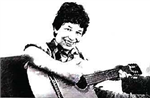
Hello, I’m David Smith. Now I’d like to share with you the story of how music has had a strong influence on my life.
Have you ever faced a time when things looked dark and you had no hope at all? Two years ago, my body ached all the time. So I went to the doctor. I was told I had a serious illness which was difficult to cure (治愈). And I thought I didn’t have much longer to live. I was very afraid and I felt so lonely and discouraged.
Then one day, I had to go through a two-hour medical treatment. The doctor wanted me to relax, so she played some music for me, and one of the songs was Happy, which has been my favorite song till now. This positive (积极的) and uplifting song gave me strength (力量) and helped me go through the darkness. From then on, I began to listen to music all the time. John A. Logan once said, “Music is the medicine of the mind.” And it’s true. Music worked wonders for me. It helped me recover (恢复) and come back to life.
Of course, I hope none of you have to experience the same kind of suffering (痛苦) that I did. However, we all go through some periods when we feel sad or lonely. During those times, music can help you in the same way that it helped me. I hope all of you will value music and make it a part of your life.
56. Was David Smith seriously ill two years ago?
57. How did the doctor help the writer to relax during the medical treatment?
58. What is the writer’s favorite song?
59. What is music like for John A. Logan?
60. What’s the passage about?
第二节(共1小题;满分15分)
根据要求完成短文写作。
61.学校英文校刊主编读了第一节(回答问题)中David Smith的故事后,深受触动,发起主题为“What does music bring to me?”的征文。你和同学就此进行了讨论。请综合下图所示的笔记内容,并作适当拓展,写一篇短文投稿。
要求:(1)80词左右(标题和开头都已给出,不计入总词数);
(2)文中不得出现真实人名和校名。
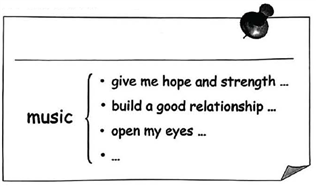
What does Music Bring to Me?
Music is like a key, which opens a door to the world for me. ________________________________________
________________________________________________________________________________________________________________________________________________________________________________________
参考答案及评分标准
一、参考答案
第一部分 听力
第一节
1—5 CBACA
第二节
6—10 BACCA 11—15 CBCCA 16—20 ABBAC
第二部分 阅读
第一节
21—25 ABACC 26—30 BCBCB
第二节
31—35 DACBE
第三部分 语言运用
第一节
36—40 CABAB 41—45 CBACB
第二节
46. marks 47. to 48. meanings 49. to represent 50. lucky
51. are given 52. richness 53. their 54. and 55. Certainly
第四部 分读写综合
第一节
56. Yes.
57. By playing some music fer him.
58. Happy.
59. The medicine of the mind.
60. How music has had a strong influence on David Smith’s life.
第二节
61.
What does Music Bring to Me?
Music is like a key, which opens a door to the world for me.
Music brings me hope and strength during hard times, offering words of wisdom that guide me through lift’s challenges. Music helps me build a good relationship. When I was young, I used to be shy. As I took up playing the guitar to deal with my shyness, I made lots of friends. Besides, music opens my eyes. Through music, I can broaden my horizons, sharpen my mind, and deepen my understanding.
Also, music reminds me of some happy memories. It makes me remember the love and care my teachers and friends have given me. It tells me the best things in life are free.
Overall, music enriches my life, making it more meaningful and fulfilling. I hope all of us will value music and make it a part of our life.